
What copy trading means
This page is for someone who has heard of copy trading and has not used it. It uses the help pages and the public pages of cTrader Copy, read on 6 November 2026, to say what the word covers, who the parties are, what is handed over and what is not. It gives no figure from a real strategy and takes no side.
The short version
A trader, called the strategy provider, trades on their own account. You allocate money to that trader's strategy. The platform then repeats the provider's trades on a separate account of yours, in a size set by the ratio of your money to theirs, and you can stop whenever you want. The provider is paid by fees that come out of your account. That is all of it; the rest of this site is detail.
Who is who when a trade is copied
The help pages of cTrader Copy name four parties. The wording of the third column is a plain paraphrase of the pages. Sources: help.ctrader.com/ctrader-copy and help.ctrader.com/ctrader-copy/investing-in-strategies, read on 6 November 2026.
| Party | Who it is | What it does in a copy |
|---|---|---|
| Strategy provider | A trader who offers a strategy for copying | Trades on their own account; every trade is available to be copied |
| Investor (you) | A cTrader user who allocates funds to a strategy | Allocates money, can add or remove funds, set an equity stop loss or stop |
| Platform (cTrader Copy) | The copy service inside cTrader | Repeats the provider's trades on your copy-trading account, sized by the ratio of equities |
| Broker | The company holding the accounts | Sets the account type, the leverage, the size limits and whether copying is offered to a client |
What you hand over, and what stays with you
What you hand over is the choice of trades: the provider decides, the platform repeats. You do not pick entries, exits or sizes of individual trades. What stays with you is the money and the result. The trades run on a copy-trading account made from your funds, so the profit or loss of every copied trade is on your side. The provider's own record belongs to the provider's account. Nothing on the pages moves a loss from your account to anyone else.
A copy is not a signal
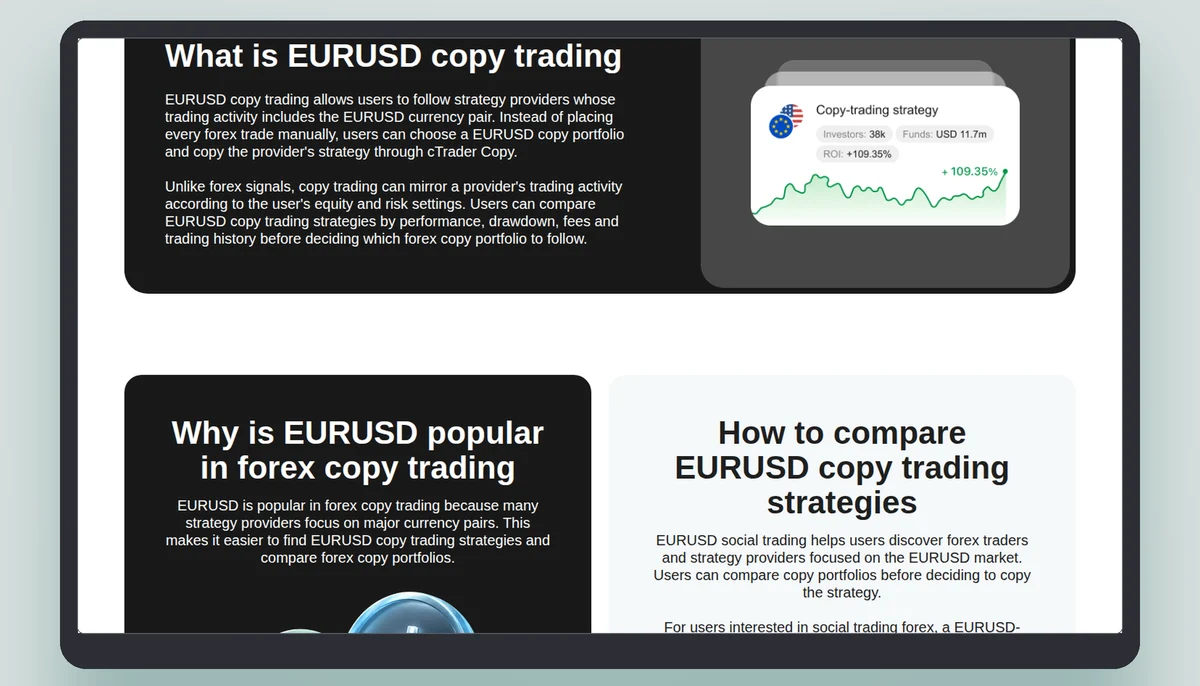
cTrader's page for euro-dollar copying puts the difference in one sentence: unlike forex signals, copy trading can mirror a provider's trading activity according to the user's equity and risk settings. A signal is a message about a trade that the reader then places. A copy places the trade on your account for you.
How big is a copied trade
The help page gives the rule: your equity divided by the provider's equity, multiplied by the provider's volume. Its example is a provider with USD 4,000 who opens 4 lots, copied by an investor with USD 1,000 as 1 lot. With invented numbers of this page: a provider with USD 10,000 and an investor with USD 500 give a ratio of 1 to 20, so a provider's 2.0 lots become 0.10 lots. Your account follows the provider in proportion to its size and not in size.
What can change the size afterwards
The ratio is recalculated whenever money moves on either account. If you add funds, your positions grow. If the provider deposits, your positions shrink, and if the provider withdraws, they grow. The help page warns that a provider depositing or withdrawing while positions are open can cause losses on investors' copy-trading accounts. The size of a copy can change without a new trade.
Eight words you will meet
Plain definitions, in the order the pages use them. The first six are the pages' own terms.
| Word | What it means |
|---|---|
| Strategy | The set of all trading actions a provider executes on a live account, offered to others for copying under set conditions |
| Copy-trading account | A separate account made from the funds you allocate, used only to copy that one strategy |
| Equity | The account balance with open profit and loss included |
| Equity-to-equity ratio | Your equity divided by the provider's; it sets the size of each copied trade |
| Minimum investment | The least you can allocate to a strategy, which also limits what you can withdraw while copying |
| High-water mark | The highest value reached; a performance fee is charged on profit above it |
| Hedging account | An account that can hold opposite positions at once; copying requires one |
| Contract for difference | An agreement on a price change, not ownership of the thing priced |
What the pages say you can do while copying
You can add funds, remove funds, set an equity stop loss, or stop copying. Stopping closes the copied positions and sends the money back to your main account, and the fees due at that moment are charged. The equity stop loss is the platform's own protection, and the help page says it is not a guaranteed price: once triggered, positions are closed, but the final equity can be lower than the level set.
In brief
Read next
Questions a beginner asks about copying
Do I choose the trades?
No. The provider trades and the platform repeats; you choose the strategy and the amount.
Who loses if the provider's trade loses?
The investor, on the copy-trading account. The pages describe no transfer of loss.
Is a copy the same size as the provider's trade?
No. It follows the ratio of the two equities, then the broker's size limits.
Can I stop?
The help page says an investor can stop copying at any time.
The broker this site links to
This site links to FxPro, which cTrader's list marks as a copy-enabled broker. A copied trade is a leveraged contract on a price, not ownership of anything. Read the terms before you decide anything.